

Moonshot: Who's With Me?
Ayn Rand was uncharacteristically giddy on the topic of moon travel, and maybe we should be, too.

“For once, if only for seven minutes, the worst among those who saw it had to feel not 'How small is man by the side of the Grand Canyon!' but ‘How great is man and how safe is nature when he conquers it!'"
—Ayn Rand, “Apollo 11,” 1969
Uh, we sent four astronauts to the moon for the first time in 50 years?
Did anyone you meet out there in the world today happen to mention it? Were you too busy, distracted, doomscrolling, stuck-in-traffic or otherwise engaged to notice or care?
TL;DR:
“We’re going back to the f*cking moon!”
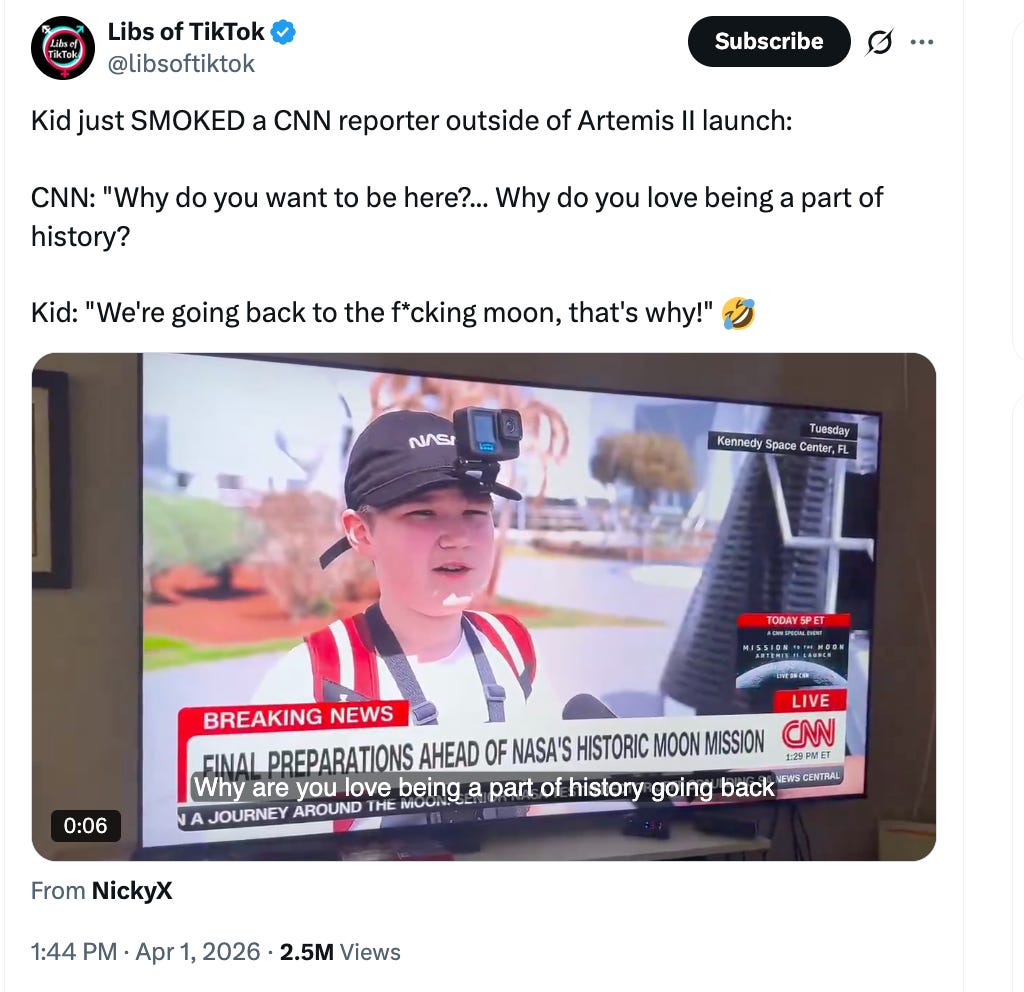
The kid’s vid: here.
Four astronauts got launched out of Kennedy Space Center on a ten-day mission 250,000 miles from earth to loop around the moon.
Is this amazing?
Not to much of Podcastistan. They’ve already de-bunked the funk. Not to the left, who is stuck on repeat. “Colonization!” International Law!
Do you ever get the sense that some of these forces might be engaged in a little project we call “demoralization?”
Ayn Rand wondered that over 50 years ago. She offered an uncharacteristically giddy first-person account of witnessing the July 16, 1969 launch of Apollo 11 for The Objectivist. She — as you realize — was no fan of government spending. But on space travel, she gave it a pass. She was in love.
“The rocket was almost above our heads when a sudden flare of yellow-gold fire seemed to envelop it — I felt a stab of anxiety, the thought that something had gone wrong, then heard a burst of applause and realized that this was the firing of the second stage. When the loud, space-cracking sound reached us, the fire had turned into a small puff of white vapor floating away. At the firing of the third stage, the rocket was barely visible; it seemed to be shrinking and descending; there was a brief spark, a white puff of vapor, a distant crack — and when the white puff dissolved, the rocket was gone.
These were seven minutes.
What did one feel afterward? An abnormal, tense overconcentration on the commonplace necessities of the immediate moment, such as stumbling over patches of rough gravel, running to find the appropriate guest bus. One had to overconcentrate, because one knew that one did not give a damn about anything, because one had no mind and no motivation left for any immediate action. How do you descend from a state of pure exaltation?
What we had seen, in naked essentials — but in reality, not in a work of art — was the concretized abstraction of man’s greatness.”
Whew. Not sure how long that honeymoon moment lasted! But just a few years later, the hangover made itself known. In an essay titled “Epitaph for a Culture,” she addressed what happened next: The collectivists ruined everything. The Apollo program had ended, and The New York Times captured the zeitgeist in a story that was — strangely enough — well reported enough to reveal the truth. The small-minded had won.
“The critics of Apollo, and there have been many, believe it was an evasion of earthly responsibility.”
Instead of championing greatness, we were to view the missions to the moon as a way to make the earth as smaller, an asterisk to the universe. One microbiologist claimed Apollo launched “a new theology of the earth” and galvanized the ecology movement, which was a means of retracting the human footprint as opposed to expanding it.
All in all, a shrinkage.
Ayn was against it, then as now.
From the first essay, “Apollo 11,” she writes of the days after the blast, warmed by the glow:
“The next four days were a period torn out of the world’s usual context, like a breathing spell with a sweep of clean air piercing mankind’s lethargic suffocation. For thirty years or longer, the newspapers. had featured nothing but disasters, catastrophes, betrayals, the shrinking stature of men, the sordid mess of a collapsing civilization; their voice had become a long, sustained whine, the megaphone of failure….Now, for once, the newspapers were announcing a human achievement, were reporting on a human triumph, were reminding us that man still exists and functions as man.”
But the naysayers — the budget critics, priorities critics, socialist philosopher set — were ready from the outset to bring it all back down. Rand noticed it early, and wrote this in her first essay, shortly after the launch:
“The publicly visible symptom of this hatred is the desire to infect man with a metaphysical inferiority complex — to hold up to him a loathsome self-image, to keep him small, to keep him guilty. The invisible part of it is the desire to break man’s spirit. The greatest threat to such a goal is any glimpse of man the hero, which the victims might catch. And nothing could offer mankind so direct, dramatic, and stunning an image of man the hero, on such a globally visible scale, as Apollo’s feat has done.”
I for one, would like to take a breather from the self-hate. You with me? In case you missed it, here’s a replay: “Three. Two. One. Booster ignition. And liftoff!”
We’re going back to the f*cking moon!
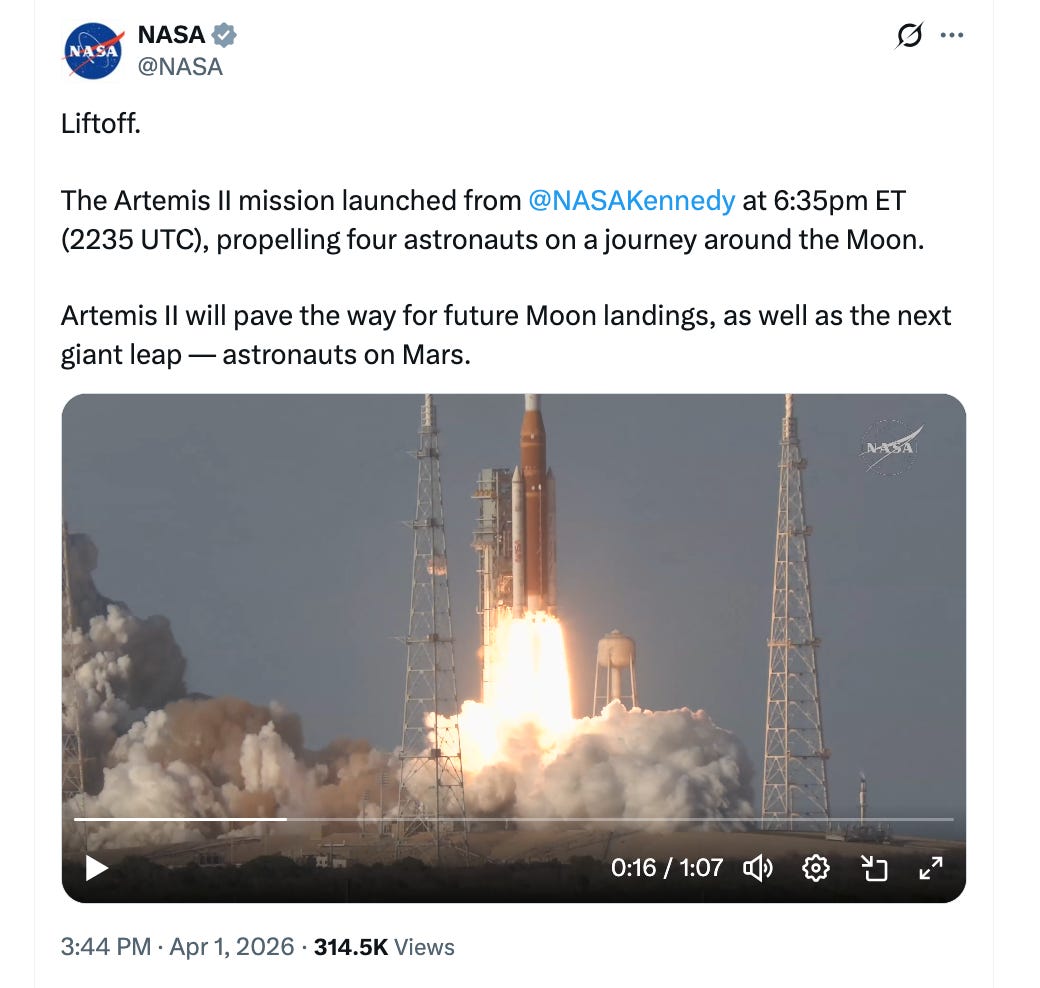
We were able to see the rocket flaring with the vapor trail from 60 miles away. It was quite awesome.
To the moon Alice!
Ha! I had no idea this was happening. As is usual for your posts you highlight some under-examined ramifications of the debate that gives us all much more to think about.